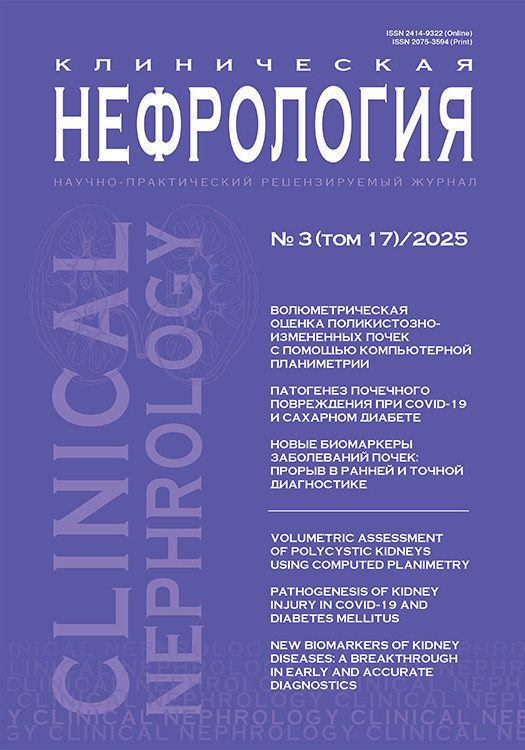
Pathogenesis of kidney injury in COVID-19 and diabetes mellitus: a review of current concepts
Acute kidney injury (AKI) is a common complication in patients with COVID-19, as confirmed by numerous studies. The prevalence of AKI in COVID-19 varies widely (0,5–80,3%) depending on the severity of the disease. AKI in COVID-19 can be caused by both direct viral effects on the kidneys and an excessive inflammatory response of the body (cytokine storm), as well as hypoxemia and coagulopathy. Direct kidney damage by SARS-CoV-2 via ACE2 receptors in the renal epithelium can lead to tubular and glomerular damage, increasing inflammation and impairing renal function. Also, in patients with diabetes mellitus (DM), these processes can be further aggravated by diabetic nephropathy, which makes the kidneys more vulnerable to damage in COVID-19. Despite this, the classical diagnostic method based on creatinine levels does not have high specificity for the early detection of AKI, since even with a 50% decrease in kidney function, creatinine levels can remain within the normal range. This can lead to late diagnosis of AKI, reduced treatment effectiveness and increased mortality rates. Therefore, further studies to assess the diagnostic accuracy and prognostic value of new markers for the early detection of AKI in patients with COVID-19 are required. This review covers key aspects such as the prevalence and clinical and morphological forms of kidney injury in COVID-19, pathogenetic mechanisms of kidney injury in COVID-19, pathogenetic mechanisms of kidney injury in diabetes mellitus and modern markers for the diagnosis of acute kidney injury in patients with diabetes mellitus and COVID-19. For this review, 25 sources from the PubMed, Google Scholar and CyberLeninka databases were used.Abdurakhimov A.Kh.
Keywords
acute kidney injury
COVID-19
pathogenetic mechanisms
diabetes mellitus
markers
KIM-1
VEGF
About the Authors
Abduhalim Kh. Abdurakhimov– Teaching Assistant of the Department of Internal Medicine, Andijan State Medical Institute. Address: 1 Yu. Atabekov st., Andijan, 170127; tel.: +9 (989) 758-29-117; e-mail: abduhalimaka@mail.ru. ORCID: https://orcid.org/0000-0003-4541-0436.Similar Articles